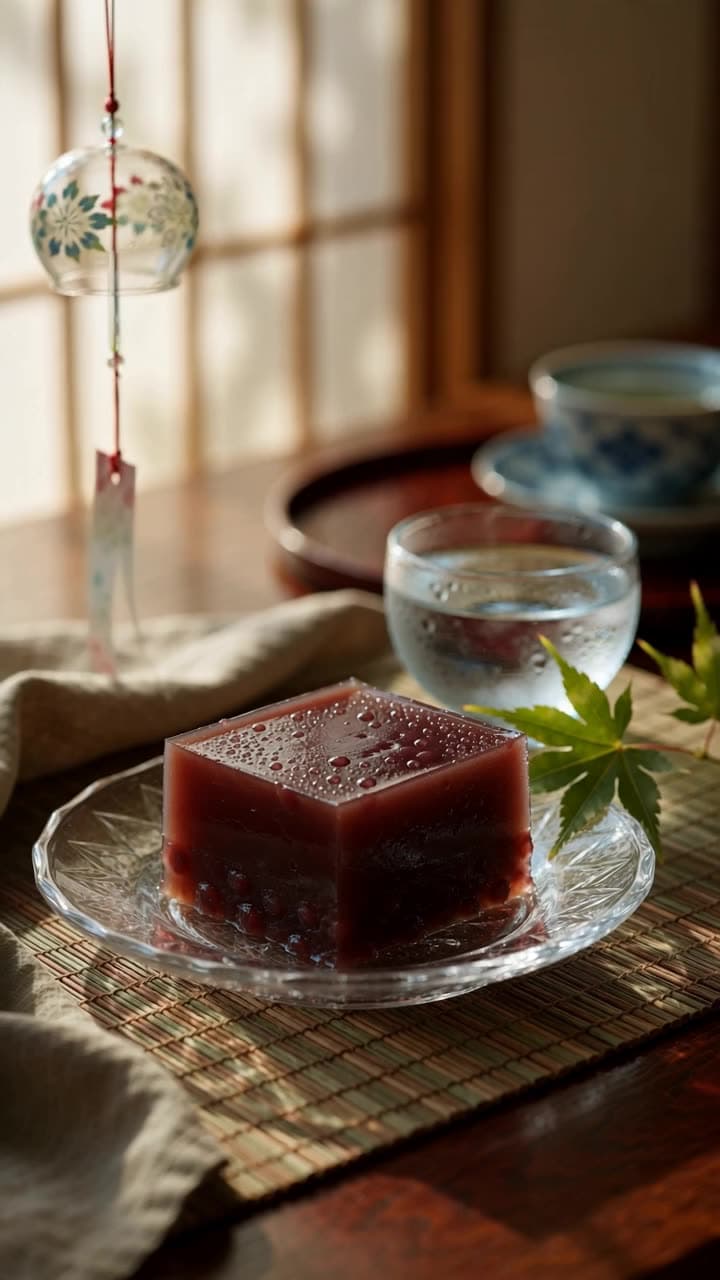
Why is it called yokan?
Yokan means "mutton soup": it began as a Chinese dish of lamb broth. Zen monks who studied in China in the Kamakura and Muromachi periods brought it to Japan as a light meal, and since they could not eat meat, they are thought to have made an imitation from azuki beans, kuzu and wheat flour. One old Edo-period essay offers a different theory, that it came from a rice-cake-like sweet called yokanko, but this is not the mainstream view.
Source (in Japanese): 虎屋 羊羹 / 虎屋FAQ 羊羹の名前 / コトバンク 羊羹
Until the early Edo period, steamed yokan was the norm. Yokan set with agar, both mizu yokan and neri yokan, was developed and spread from Edo (Tokyo), and eventually "yokan" came to mean neri yokan. When exactly neri yokan appeared differs by source: the mid-1700s according to Toraya, around 1800 according to the confectioners' association, and the late 18th century according to one encyclopedia.
Source (in Japanese): 虎屋FAQ 羊羹の名前 / 虎屋 羊羹 / 全国和菓子協会 和菓子の歴史 / コトバンク 羊羹
Neri yokan vs mushi yokan vs mizu yokan
Neri yokan is made by dissolving agar in water, adding sugar and smooth bean paste, and stirring while it boils down before setting it in a mold. It is smooth and keeps well because it has little water and plenty of sugar; at Toraya it takes three days from cooking the beans to the finished bar, and some of their yokan keep for a year. Yokan is a "poured" sweet (nagashimono), and because it is made in long bars it is also called a saomono.
Source (in Japanese): 文部科学省 食品成分表 菓子類 / 虎屋 羊羹 / 虎屋 とらやの菓子づくり / 虎屋 羊羹の賞味期限 / 全国和菓子協会 和菓子の種類 / コトバンク 和菓子
Mushi yokan is the older form: bean paste mixed with wheat flour (or kuzu) and steamed in a mold, which gives it a springy bite. It has more water and less sugar, so it spoils faster, and it usually contains wheat. Mizu yokan uses agar too, but with more water than ordinary yokan, which makes it light and refreshing: a chilled summer classic.
Source (in Japanese): 文部科学省 食品成分表 菓子類 / 虎屋 羊羹 / 虎屋FAQ 羊羹と小麦 / コトバンク 羊羹
How to eat yokan
Toraya suggests eating yokan with a kuromoji wooden pick, often cut into slices of about 2.4 cm. Besides Japanese tea, it goes well with alcohol and black tea, and it can even be paired with cream cheese in a sandwich.
Source (in Japanese): 虎屋 羊羹
The confectioners' association has its own idea for grown-ups: cut yokan into 1 cm cubes, set them on crushed ice and enjoy them with whisky or brandy.
Source (in Japanese): 全国和菓子協会 味わい方いろいろ
Other well-known yokan
Ogura yokan · Kuri mushi yokan (steamed chestnut yokan) · Imo yokan (sweet potato yokan) · Kaki yokan (persimmon yokan) · Kuri yokan (chestnut yokan) · Yuzukan (yuzu jelly)